Maybe your hands ache after opening a few jars while you're cooking dinner. Maybe your fingers feel wobbly when you hold a knife and fork, or your wrist is sore after wrestling a stiff key in the front door. When your joints move more than most people's, small everyday tasks can take more effort than they should, and leave you more tired or sore afterwards.
This is where occupational therapy for hypermobility can help. An Occupational Therapist (OT) looks at three things together: the task you're finding hard, the symptoms you notice while you do it, and the place where you do it. Then we trial small changes with you, like a different grip, a handheld aid or a new way to set up the task, and check whether they actually make that task easier for you.
Plenty of people have flexible joints and no problems at all. For others, hypermobility comes with symptoms such as ongoing joint or muscle pain, frequent sprains, joints that partly or fully dislocate, tiredness that doesn't settle with rest, or poor balance and coordination.
When hypermobility causes symptoms, a doctor may diagnose hypermobility spectrum disorder (HSD) or hypermobile Ehlers–Danlos syndrome (hEDS). Both sit on a spectrum, and how they affect daily life varies a lot from person to person, and even from day to day. You don't need a formal diagnosis to talk to an OT about the everyday tasks you're finding hard.
We start with a conversation. Which tasks are hard? When do symptoms show up? What have you already tried, and what matters most to you?
Then, where we can, we watch you do the task, ideally in your own kitchen, bathroom or workspace with your own jars, cutlery and keys. While you're doing it, we look at things like:
From there, we suggest changes to trial together. Equipment is one option, but it isn't always the first or the only one.
Handheld aids are simple tools that change how a task is done. They might give you a bigger handle to hold, more leverage, or a grippier surface so you don't need to squeeze as hard. As part of our assistive technology services, Forbes Care OTs help you choose and trial aids for the specific tasks you want to do.
We treat each aid as something to trial for a particular task, not a fix for everything. What works well for one person might not suit another, so we try it with you before recommending anything to buy. Here are a few examples.
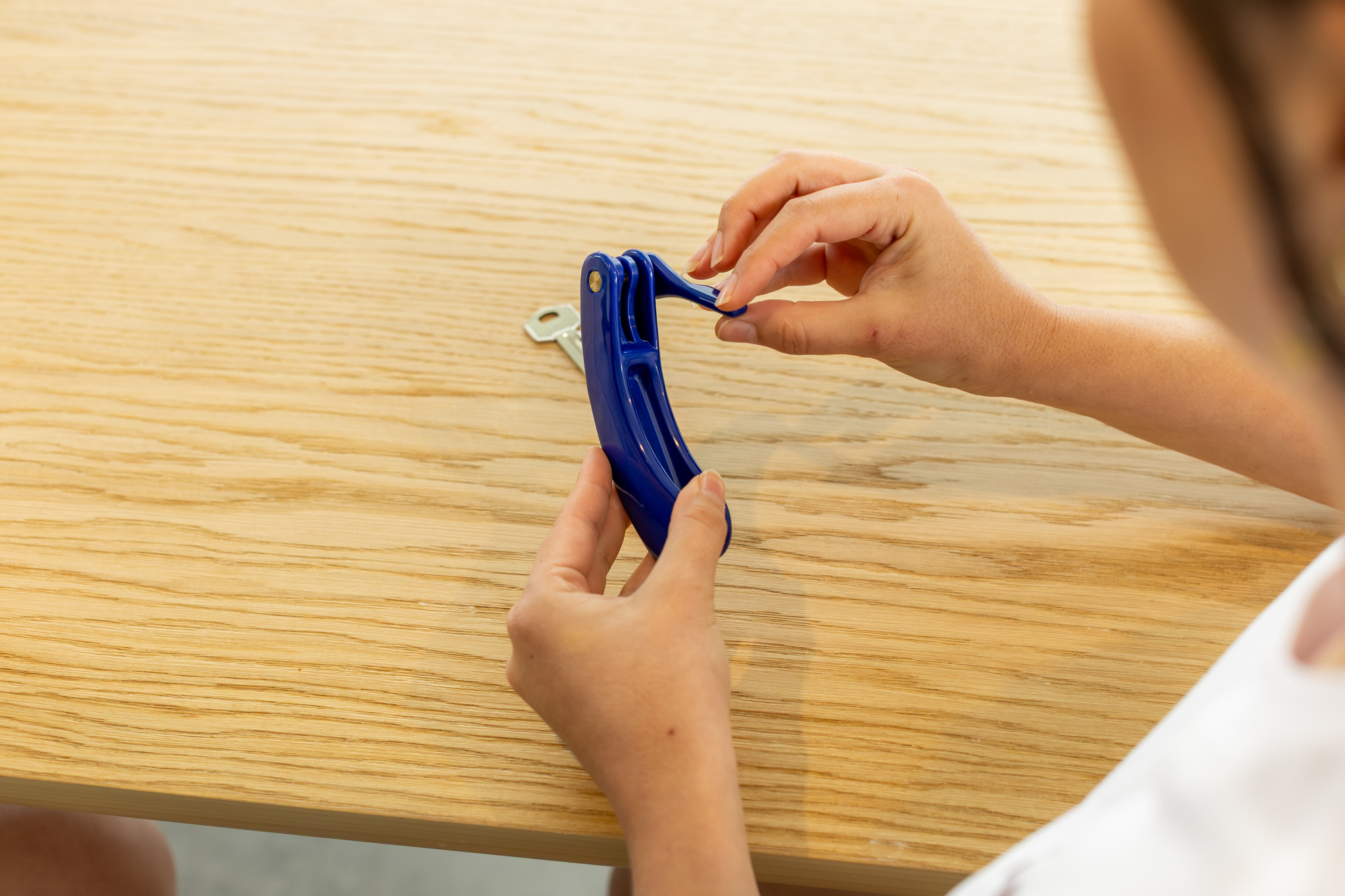
Alt text: Two hands unfolding a blue key turner with a house key attached, on a wooden table.
Key Turner
What it's for: turning a key in a front door, padlock or letterbox.
How it changes the task: the key sits inside a larger handle. Instead of pinching a small, flat key between your thumb and finger, you can hold it with more of your hand. The longer handle also gives you more leverage, so less twisting force is needed from your fingers.
What we check in a trial: whether you can hold it comfortably without your fingers bending back, whether you can line the key up with the lock accurately, whether it fits the keys and locks you use, and whether it's easy enough to fold away and carry. We'll often have you open the same lock with and without it so you can feel the difference.
[PHOTO – 0X9A3454.jpg (jar openers). Upload and insert here. Alt text: Hand using a yellow cone-shaped jar opener to twist the cap off an olive oil bottle, with a larger blue jar opener on a jar in the background.]
What it's for: opening jars, bottles and other twist-off lids.
How it changes the task: the cone-shaped opener sits over the lid and its ridged, grippy surface holds the lid for you, so you don't need to squeeze it as hard. The wider shape also gives you a bigger surface to turn. These openers come in different sizes; a smaller one suits bottle caps and a larger one suits jars.
What we check in a trial: we might ask you to open the same jar with and without the opener and compare how much effort it takes, how your wrist and fingers are positioned, and how your hands feel during and after. We also check that the size suits the lids you use most, and whether you can keep the jar steady with your other hand or need something like a non-slip mat as well.
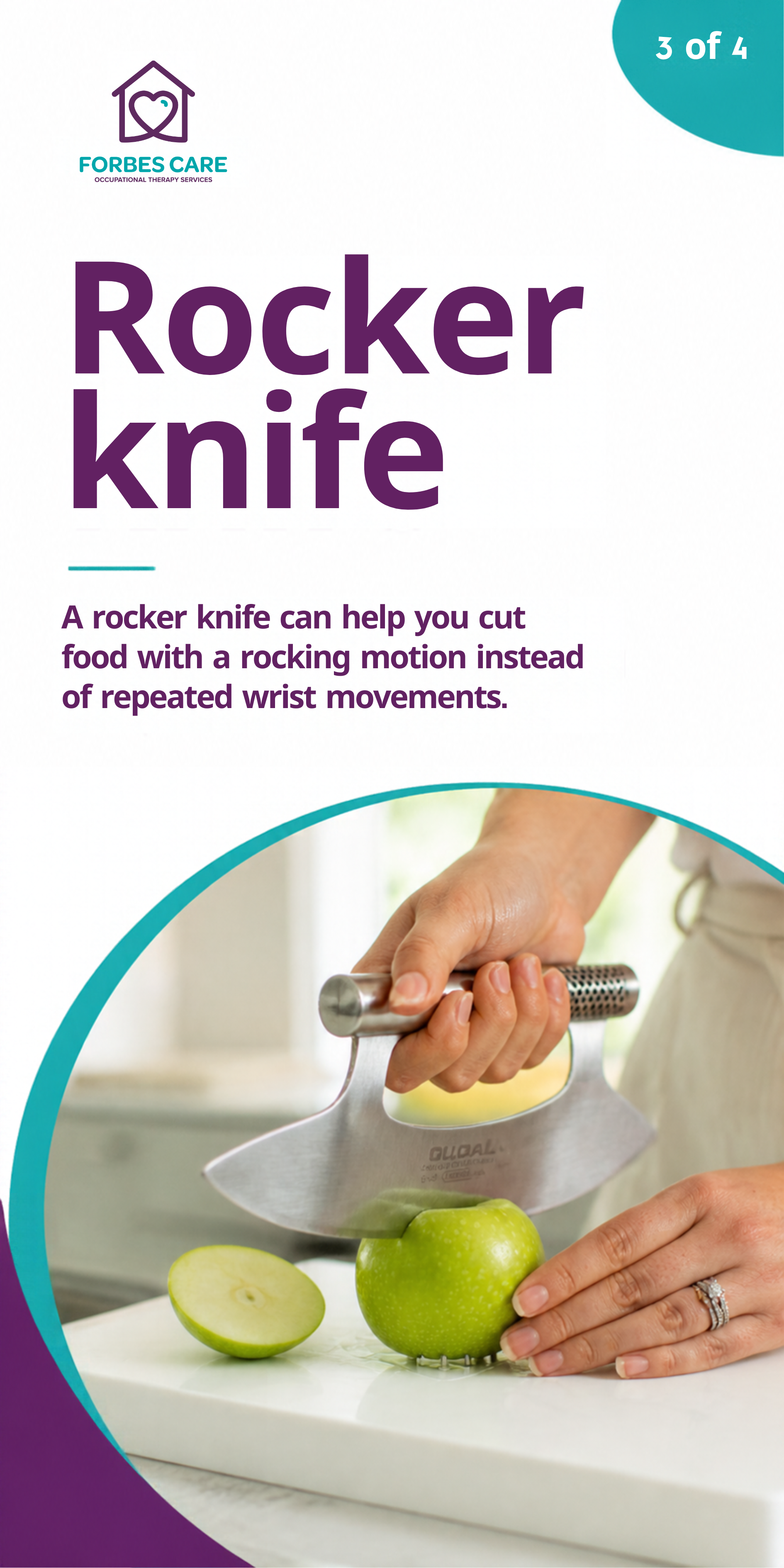
Hand pressing down on a rocker knife to cut a green apple on a white cutting board.
What it's for: cutting food on your plate or a chopping board.
How it changes the task: a rocker knife has a curved blade. Instead of sawing back and forth, you press down and rock the blade through the food. The handle sits above the blade, so you can press with your whole hand rather than relying on a tight finger grip and repeated wrist movements.
What we check in a trial: whether you have good control and can use it safely, whether the grip is comfortable, whether it cuts the foods you usually eat, and whether cutting feels easier than with your usual knife.
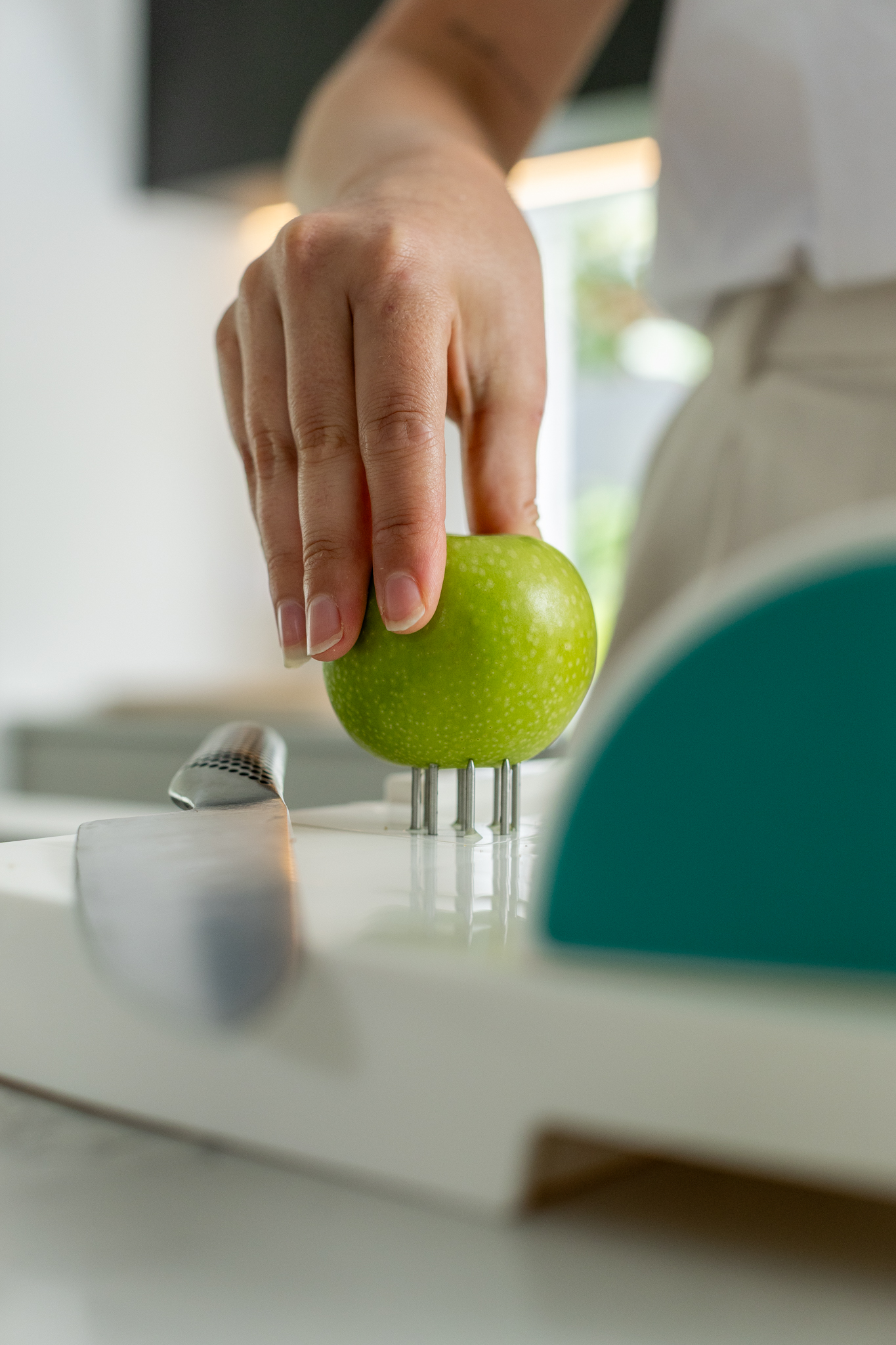
Hand placing a green apple onto the stainless steel spikes of a white cutting board, with a kitchen knife resting beside it.
What it's for: holding food steady while you cut or peel it.
How it changes the task: stainless steel spikes hold food such as fruit and vegetables in place. That means you don't need to keep a tight grip on the food with your other hand while you cut, which can be useful if holding a sustained grip is tiring or uncomfortable.
What we check in a trial: safety around the spikes, whether the board stays stable on your bench, how your bench height suits the task, and whether it works well with your knife, or with a rocker knife.
Handheld aids are only one part of the picture. An OT can also help with:
For children and teenagers, this might mean looking at handwriting, classroom seating or how they carry a school bag. We also work alongside your GP, physiotherapist and other health professionals, so everyone's working towards the same goals.
It might be worth talking to an OT if:
Forbes Care Occupational Therapists see children through to older adults, and work with NDIS participants, Support at Home and DVA clients, and private clients. We visit clients at home across the Sunshine Coast and surrounding areas, and also see clients at our Buderim clinic.
To make an enquiry or send a referral, contact our team, call 07 5220 8909 or email hello@forbes.care.
Get ready to be inspired, informed, and involved in the future of Occupational Therapy! We look forward to welcoming you to the Next Gen OT Summit.
To book an appointment with an occupational therapist, please call 07 5220 8909 or submit a referral form below.
General Practitioners can send referrals to:
Email: hello@forbes.care
Fax: 07 5302 6482
Address: Shop 15/102 Burnett St, Buderim
Join our team of passionate occupational therapists and help individuals reach their full potential. We offer a supportive work environment, opportunities for professional growth, and the chance to be part of a dynamic team.
Ready to take the next step in your career? Visit our careers page to learn more about our open positions and apply today!


Forbes Care and all those that dwell within, acknowledge the traditional Custodians of the land, the Gubbi Gubbi people, and pay our respects to Elders past, present and emerging.
Forbes Care welcomes all peoples who identify as LGBTQIA+, and those with other diverse genders and sexualities.

